
The game of English billiards is performed on a comparatively large desk, often 6 toes 1.5 inches by 12 toes (1.9 by 3.7 m); it's played with three balls as in carom-a plain white, a white with a spot, and a red. Carom billiards is played on a table usually 5 by 10 ft (1.5 by 3 m) or 4.5 by 9 toes (1.4 by 2.7 m). Angled rails of hardened rubber or synthetic rubber, often called cushions, rim the internal edge of the table. The cue is a tapered rod of polished wooden or synthetic materials, ranging in size from about forty to 60 inches (one hundred to a hundred and fifty cm). The normal mahogany billiards desk is still in use, however tables at the moment are generally made from different woods and synthetic materials. The table measurement of the pool recreation is three and a half toes by seven feet. There are three ways of scoring: (1) the shedding hazard, or loser, is a stroke through which the striker’s cue ball is pocketed after contact with one other ball; (2) the profitable hazard, or pot, is a stroke through which a ball apart from the striker’s cue ball is pocketed after contact with one other ball; (3) the cannon, or carom, is a scoring sequence during which the striker’s cue ball contacts the 2 other balls successively or simultaneously.
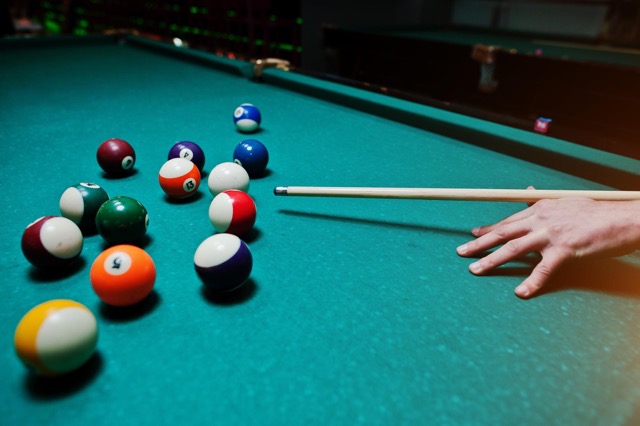 Determine which balls you want the cue ball to contact and in what order. Aim your cue stick accordingly, considering any English or spin that is likely to be mandatory for attaining your required end result. In billiards-whether or not it’s three-cushion, English pool, or snooker-your mindset could be just as important as your shot. More usually, it’s the calm, composed, and quietly assured individual who takes management of the sport. Aim your cue stick accordingly, maintaining in mind that you’ll need to strike the cue ball with enough drive to achieve your required end result while maintaining control over its path. Carom shots require precise control of the cue ball’s speed and direction, making them an ideal technique to showcase your mastery of cue ball manipulation. The small end of the cue, with which the ball is struck, is fitted with a plastic, fibre, or ivory reinforcement to which is cemented a leather cue tip. Play additional rounds until the tip of the game. The rock, broken up into items about the size of marbles, having been dried and conveyed to the stock-home, the surplusage was robotically carried out from the other finish of the stock-home by con- veyors, to pass via the following process, by which it was reduced to a powder.
 The sport is played with three balls, two white and one purple, with one of the white balls having a small red dot, or spot, to differentiate it. The opposite principal video games are performed on tables that have six pockets, one at each nook and one in every of the long sides; these games include English billiards, performed with three balls; snooker, played with 21 balls and a cue ball; and pocket billiards, or pool, played with 15 balls and a cue ball. In play, the article is to stroke the cue ball in order that it hits the two object balls in succession, scoring a carom, or billiard, which counts one level. It involves hitting the cue ball towards a number of cushions earlier than hitting your target ball into a pocket. The sport is performed with 22 balls, made up of 1 white ball (the cue ball), 15 crimson balls, and 6 numbered coloured balls together with one yellow 2, one green 3, one brown 4, one blue 5, one pink 6, and one black (valued at 7 factors).
One of many white balls (plain or spot) serves because the cue ball for each player, the crimson ball and other white ball serving as his object balls. Visualizing smooth strokes, precise cue ball paths, and calm execution primes the brain for achievement. It may be inferred that it developed from a variety of games through which propelling a ball was a predominant feature. Different types of the game are typically played in certain groups of countries or areas of the world, though most of the games cross many national boundaries. The sport of carom billiards is still performed primarily in France and different European international locations and to a lesser diploma within the United States and has many players in Japan, Indonesia, the Philippines, Taiwan, and South Korea and in Central America, South America, Africa, and the Middle East. The game of English billiards is most popular in Britain and the former empire countries.
